


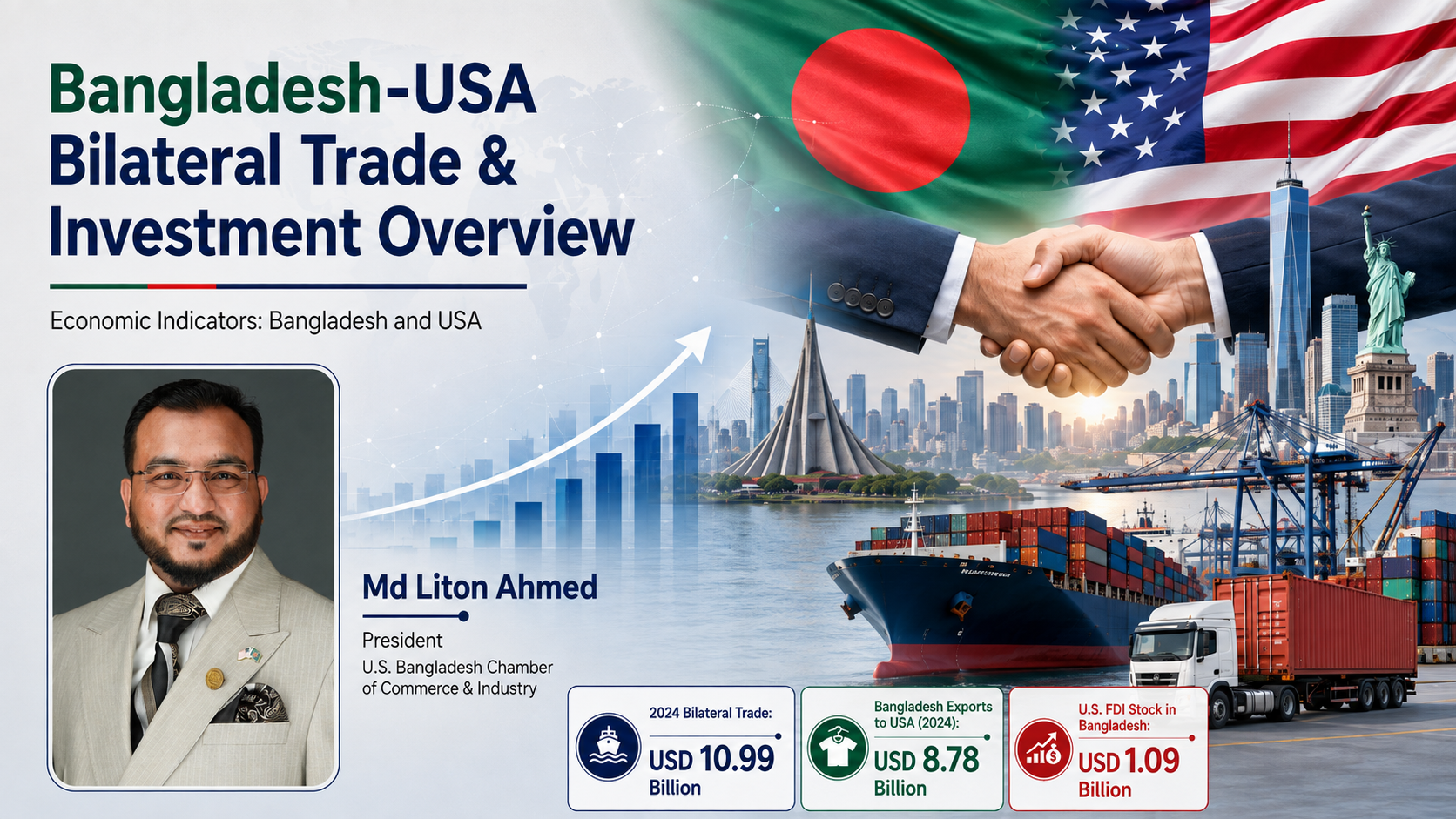
The economic relationship between Bangladesh and the United States continues to be one of Bangladesh’s most important international trade partnerships. The United States remains a major destination for Bangladeshi exports, while U.S. investment contributes to several important sectors of Bangladesh’s economy.
With Bangladesh strengthening its manufacturing base and seeking greater foreign direct investment, the bilateral relationship offers significant opportunities to expand beyond traditional apparel trade into technology, energy, pharmaceuticals, financial services, agriculture, engineering, and other emerging sectors.
Bangladesh and USA: Key Economic Indicators
The two economies differ significantly in scale but offer complementary opportunities for trade and investment.
Bangladesh
- GDP: USD 450.46 billion
- GDP per capita: USD 2,625
- Total goods exports: USD 44.47 billion
- Total goods imports: USD 63.23 billion
- Total service exports: USD 6.64 billion
- Total service imports: USD 9.69 billion
- Global outbound investment: USD 30 million
Bangladesh’s GDP is composed of approximately 51.04% services, 37.95% industry, and 11.02% agriculture.
United States
- GDP: USD 29.18 trillion
- GDP per capita: USD 85,809.9
- Total goods exports: USD 2.06 trillion
- Total goods imports: USD 3.38 trillion
- Total service exports: USD 1.153 trillion
- Total service imports: USD 840.88 billion
- Global outbound investment: USD 266.37 billion
Services represent approximately 79.7% of U.S. GDP, demonstrating the highly developed and service-oriented structure of the American economy.
Bangladesh–USA Bilateral Trade
The United States is one of Bangladesh’s most significant export markets.
During FY 2023–2024, Bangladesh exported approximately USD 7.60 billion worth of goods to the United States while importing approximately USD 2.54 billion from the U.S.
This resulted in:
- Bangladesh exports to USA: USD 7.60 billion
- Bangladesh imports from USA: USD 2.54 billion
- Total bilateral trade: USD 10.14 billion
- Trade balance in Bangladesh’s favor: USD 5.06 billion
On a calendar-year basis, bilateral trade reached approximately USD 10.99 billion in 2024, including USD 8.78 billion of Bangladeshi exports to the United States and USD 2.21 billion of U.S. exports to Bangladesh.
The figures demonstrate both the importance of the American consumer market for Bangladesh and the potential for further diversification of bilateral commerce.
Bangladesh’s Major Exports to the United States
Bangladesh’s export relationship with the United States remains heavily concentrated in apparel and textile products.
Among the leading individual products exported from Bangladesh to the U.S. are:
- Men’s or boys’ cotton trousers and breeches — USD 1.448 billion
- Women’s or girls’ cotton trousers and breeches — USD 765.86 million
- Cotton T-shirts, singlets and vests — USD 658.29 million
- Men’s or boys’ cotton shirts — USD 468.51 million
- Cotton jerseys and pullovers — USD 385.84 million
- Men’s or boys’ synthetic-fiber trousers — USD 293.00 million
- Hats and other headgear — USD 222.39 million
- Leather-upper footwear — USD 132.65 million
Other important products include knitted cotton shirts and women’s or girls’ cotton undergarments.
The data demonstrates Bangladesh’s strong position as a major supplier of apparel and consumer products to the American market.
Major U.S. Exports to Bangladesh
Bangladesh also imports a broad range of industrial materials, commodities, equipment, and manufactured products from the United States.
Major categories include:
- Base metals and articles of base metal — USD 609.06 million
- Mineral products — USD 599.13 million
- Vegetable products — USD 391.71 million
- Textiles and textile articles — USD 375.52 million
- Machinery, mechanical appliances and electrical equipment — USD 171.53 million
- Chemical and allied industry products
- Optical and photographic equipment
- Prepared food products
- Plastics and rubber products
- Pulp and other fibrous cellulosic materials
These imports highlight the complementary nature of the relationship: Bangladesh supplies consumer and manufactured goods to the United States while purchasing raw materials, machinery, technology-related products and industrial inputs from the American market.
U.S. Foreign Direct Investment in Bangladesh
Trade represents only one dimension of the relationship. American companies are also important investors in Bangladesh.
According to the report, U.S. FDI stock in Bangladesh reached approximately USD 1.09 billion from 2001 through the end of March 2025.
The United States was identified as Bangladesh’s 7th-largest source of FDI, representing approximately 5.78% of Bangladesh’s total FDI stock.
Annual net U.S. FDI inflows included:
- FY 2019–20: USD 193.14 million
- FY 2020–21: USD 129.46 million
- FY 2021–22: USD 426.59 million
- FY 2022–23: USD 146.40 million
- FY 2023–24: USD 89.28 million
The particularly strong inflow recorded during FY 2021–22 illustrates the potential for significantly larger U.S. investment when commercial opportunities and investor confidence align.
Where Are American Companies Investing in Bangladesh?
U.S. investment is distributed across several important sectors.
Major sectors of U.S. investment stock include:
- Insurance — USD 228.28 million
- Banking — USD 186.07 million
- Textile and wearing — USD 133.26 million
- Non-Bank Financial Institutions — USD 132.74 million
- Power — USD 126.73 million
- Gas and petroleum — USD 97.48 million
- Trading — USD 69.49 million
Additional investment is present in pharmaceuticals and chemicals, telecommunications, construction, agriculture and fishing, food products, leather and other sectors.
Moving Beyond Traditional Trade
Bangladesh’s success in apparel exports provides a strong foundation, but the next phase of Bangladesh–USA economic cooperation should focus increasingly on diversification.
Potential areas for expanded collaboration include:
ICT and Digital Economy: Bangladesh’s growing technology and outsourcing ecosystem can create opportunities for U.S. technology companies, investors and service providers.
Pharmaceuticals and Healthcare: Bangladesh’s pharmaceutical manufacturing capabilities provide opportunities for investment, technology partnerships and market development.
Energy and Infrastructure: Existing U.S. investment in power, gas and petroleum shows the strategic importance of this sector.
Advanced Manufacturing: Machinery, engineering products, electronics and value-added manufacturing could help Bangladesh diversify its export base.
Agriculture and Food Processing: Agricultural technology, cold-chain infrastructure and value-added food production provide potential areas for bilateral cooperation.
Financial Services: Significant existing U.S. investment in banking, insurance and NBFIs provides a foundation for further financial-sector collaboration.
Bangladesh’s Opportunity in the U.S. Market
Bangladesh already has a strong commercial presence in the American market. The challenge for the coming years will be to transform that relationship from one dominated primarily by garments into a broader economic partnership covering trade, investment, technology, innovation and knowledge transfer.
Greater engagement between businesses in both countries can help:
- Diversify Bangladesh’s exports
- Attract higher levels of U.S. FDI
- Develop new manufacturing industries
- Expand SME participation in international trade
- Build stronger B2B partnerships
- Increase technology and knowledge transfer
- Create employment and entrepreneurship opportunities
- Strengthen supply-chain cooperation
- Connect Bangladeshi companies with the U.S. market
The Road Ahead
Bangladesh and the United States already share a substantial bilateral economic relationship, with annual goods trade exceeding USD 10 billion according to the figures presented in the DCCI overview.
However, the size of the U.S. economy, combined with Bangladesh’s expanding industrial and manufacturing capabilities, suggests that the potential relationship is considerably larger.
The future should therefore focus not only on “Made in Bangladesh” exports to the United States, but also on “Invest in Bangladesh” opportunities for American businesses.
Through stronger private-sector engagement, investment facilitation, business-to-business matchmaking, trade missions and policy dialogue, Bangladesh and the United States can build a more diversified and mutually beneficial economic partnership.
Sources
Economic and trade figures are based on the Bangladesh–USA Bilateral Trade & Investment Overview, prepared by the Trade Facilitation Department of the Dhaka Chamber of Commerce & Industry (DCCI) on September 24, 2025. The report cites data from BBS, Export Promotion Bureau (EPB), Bangladesh Bank (BB), UNCTAD, World Bank, WTO and International Trade Centre (ITC).




Post a comment
Related Posts
July 30, 2026
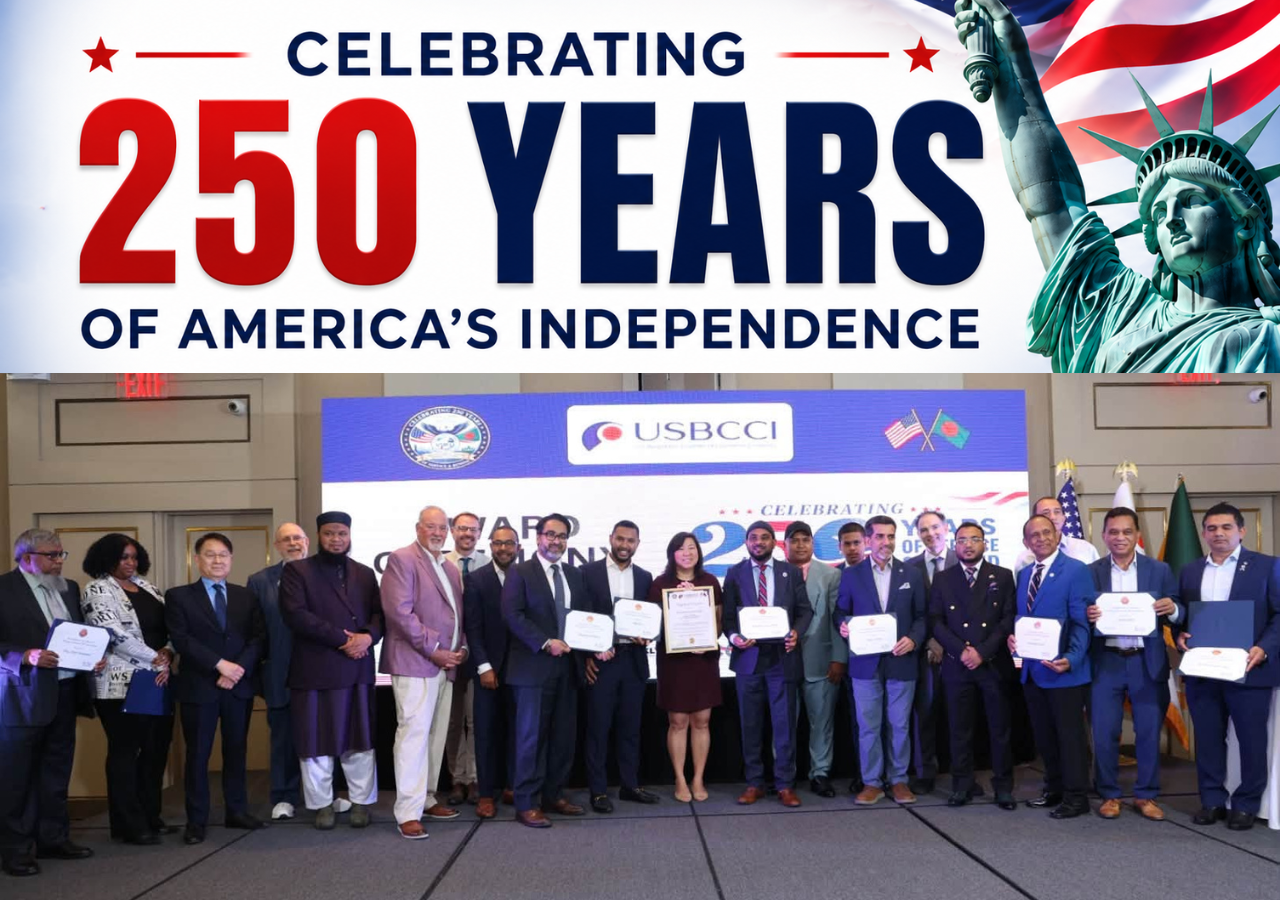
USBCCI Marks America’s 250th Anniversary with a Celebration of Service and Leadership
USBCCI Marks America’s 250th Anniversary with a Celebration of Service and Leadership The U.S.-Bangladesh Chamber…

July 6, 2026
যুক্তরাষ্ট্রের বাজারে বাংলাদেশি পণ্যের নতুন দিগন্ত: এখনই সময় রপ্তানি বৈচিত্র্যের
লেখক: মোঃ লিটন আহমেদ Founder & President, U.S. Bangladesh Chamber of Commerce & Industry…
July 2, 2026
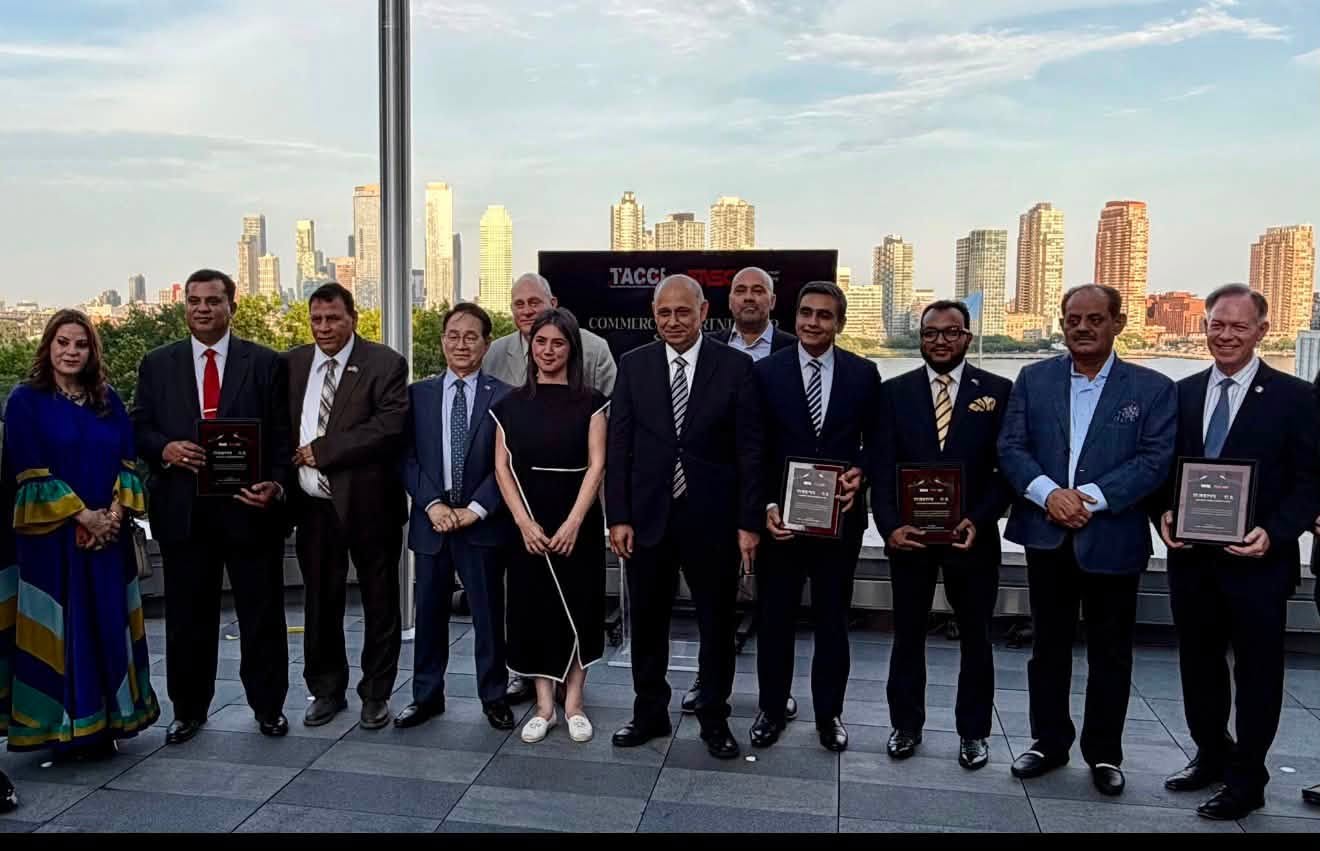
USBCCI Strengthens Global Business Collaboration at TACCI USA Strategic Partnership & MoU Signing Ceremony
New York: The U.S.-Bangladesh Chamber of Commerce & Industry “USBCCI” participated in the prestigious Strategic…

May 21, 2026
Intex Bangladesh 2026 to showcase global textile sourcing solutions in Dhaka
Intex Bangladesh 2026, the Bangladesh edition of the Intex South Asia textile sourcing series, is…